How to record a video message that sounds like you
About a minute, one phone, no gear. A simple shape for what to say, how to get the light and sound right, and what to do when the nerves kick in.
By the Warmcut team · · 8 min read

The link has been sitting in your messages since Tuesday. Tonight the house is finally quiet, so you sit on the couch, hold the phone up and tap record. Your face looks back at you, lit from the ceiling, and you hear yourself say, "Um. Hi." You stop, and delete it.
Nearly everyone's first take goes like that. It does not mean you are bad at this. It means you are ready for take two.
Here is how to record a video message, in short: know your first and last sentence, give the middle one real moment, and keep the whole thing to 30 to 60 seconds. Get light onto your face, pick a quiet room with soft furnishings, hold the phone at arm's length with the lens level with your eyes, and allow yourself three takes. The details, lines to borrow and a word on nerves are below.
What do you say in a 30-second video message?
Three parts are enough, whether you have thirty seconds or a full minute.
| Part | How long | What it does |
|---|---|---|
| Hello | About 5 seconds | Who it is for, and who you are |
| One moment | 20 to 45 seconds | Something real you saw or shared |
| Send-off | 5 to 10 seconds | One warm closing line, then stop |
The middle is the part people remember. One moment, told with one small detail, beats a list of good qualities. "You're so generous" is kind. "You always brought a spare umbrella for whoever forgot theirs" is something they can see.
Put together, it can be as short as this:
"Hi Dee. It's Anika, from the Thursday walking group. The first thing I thought of was the morning it bucketed down and you turned up anyway, with a spare umbrella for whoever forgot theirs. That's you, all over. Have a lovely day. See you Thursday."
Lines to start each part
Hellos
- "Hi Rosa. It's Tom, from two doors down."
- "Hello, Mr Hughes. It's Sam's mum, Lena."
- "Hey Jules. Your cousin Mark here, from Brisbane."
Ways into the moment
- "The first thing I thought of was..."
- "There's one afternoon I keep coming back to..."
- "Something you did that you probably didn't think twice about..."
- "What I've always noticed about you is..."
Send-offs
- "That's it from me. Enjoy every minute."
- "Proud of you. See you soon."
- "Thank you, truly. Go well."
- "Love you. Talk on Sunday."
Learn your first sentence and your last one. The middle can wander a little: if you know where you start and where you stop, you are far less likely to freeze. For words that suit a particular day, see what to say in a birthday message, farewell messages for a coworker and graduation messages for every path.
Where should you record it for good sound?
People will forgive a soft picture. They will not forgive a voice they cannot hear, and sound is mostly about the room.
- Choose a soft room. A bedroom or lounge with curtains, a couch and a rug sounds close and warm. Tiled bathrooms, hallways and empty rooms echo.
- Switch off the ceiling fan and the air-con for the minute you record. Both hum, and a fan blows air straight across the microphone.
- Shut the door, then listen for ten seconds. You will hear things you have stopped noticing: the fridge, the road, a mower down the street.
- Find the microphone. On most phones it sits on the bottom edge. Keep your fingers, and the flap of a wallet case, clear of it.
- Stay close. At arm's length, your voice is louder than the room. Prop the phone on the other side of the room and the room wins.
How do you get the light right?
- Light on your face, never behind your head. A bright window behind you turns you into a silhouette. Turn round so the daylight falls on your face, or sit side-on to it.
- At night, move a lamp. A ceiling light leaves shadows where your eyes should be. Bring a lamp round in front of you, a little above eye height, or record in the morning instead.
- Do the eye test. If you can see your eyes clearly on the screen, the light is good enough.
Can you record a video message outside?
Yes, if you plan for wind, sun and noise.
Wind. A breeze you can barely feel can roar on a phone microphone. Turn your back to the wind so your body shelters the phone, or stand on the sheltered side of the house, a wall or a parked car. If you film in the camera app on an iPhone 16 or later and upload the clip, wind noise is reduced automatically when it records in stereo or spatial audio (Apple, as at October 2026). That helps with a breeze. It cannot fix a gale.
Sun. Midday sun from straight above makes everyone squint and puts dark shadows under the eyes. Look for open shade, where the light is even: a verandah, a carport, the shady side of the house. Shade under a tree is blotchy, with patches of sun moving across your face. Early morning and late afternoon light is softer again.
Noise. In late spring and summer, cicadas can drown out a whole sentence. So can lorikeets at dusk and the leaf blower next door. If you can hear them, the phone can too.

How should you hold the phone?
- About arm's length away, held steady or propped on something. Any closer and the wide selfie lens does unkind things to noses.
- Lens level with your eyes. From below, the camera looks up your nose. From above, it looks down on you. Lift the phone, or raise whatever it leans on.
- Head and shoulders in the frame, with a little space above your head. Nobody needs the whole room.
- Check what is behind you before you start: the washing on the clothes horse, an open bathroom door, a pile of mail with your address on top.
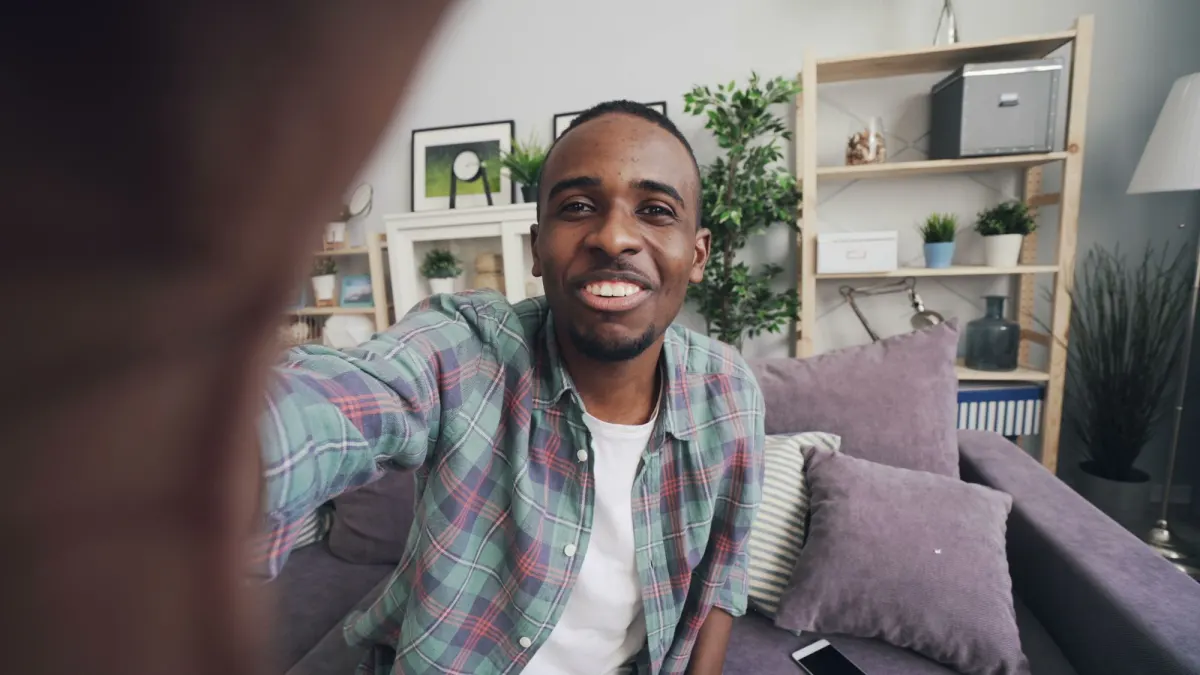
Upright is fine for most recording links, including Warmcut's, which frames portrait clips for the film. If a friend is editing the clips by hand, ask which way they want them; the step-by-step group video guide explains why it matters.
How many takes should you do?
Allow three. The first is a warm-up: your voice is still finding its level and your face is still deciding what to do. The second is usually the one. The third is for when something went wrong: the dog barked, or a name came out backwards. After that, most people start polishing the life out of it. Send the best of the three.
- Do not stop for a stumble. Pause, take a breath and say the sentence again. Warmcut trims pauses and false starts, so a restart in the middle rarely needs a whole new take. If a friend is editing by hand, a clean take saves them time.
- Watch it back once, with the sound on. Check two things only: can you hear every word, and is your whole face in the picture? Ignore your hair.
What if you hate seeing yourself on camera?
You are in good company, and there are reasons it feels so odd.
- The face on playback is not the one you know. You know your own face from the mirror, flipped. In a 1977 study, people preferred a mirror-image print of their own face, while their friends and partners preferred the true print. The version that looks slightly wrong to you is the one everyone else is used to.
- Your voice sounds strange for a similar reason. You usually hear yourself partly through your own head. The recording is how you sound to everyone else, every day.
- Nobody is watching as closely as you are. Psychologists call it the spotlight effect: in studies published in 2000, people wearing a potentially embarrassing T-shirt overestimated how many others noticed what was on it. The person watching your message is listening to what you say.
A few things that help:
- Stand up if sitting makes you sound flat.
- Record one take that does not count. Tell yourself it is practice. It is often the one you keep.
- Put a person behind the phone. Ask someone you like to sit just behind it and listen. You will find yourself talking to them.
- Breathe out slowly, smile, then tap record.
Recording a video message for a group film?
The steps are the same, and your part is small. With Warmcut, you tap the link the organiser sent, record about a minute on your phone, watch it back and send it. There is no app to download and no account to make. The clips from everyone come back as one film, in story order, with music and captions.
If you are helping a child record, keep it short and let them say it their way; the tips for helping a child record a thank-you message work for any occasion.
Before you tap record
- First and last sentence ready
- Light on your face, not behind you
- Fan and air-con off, door shut
- Phone at arm's length, lens level with your eyes
- A quick look at what is behind you
- Three takes, then send
A minute of you, sounding like you, is the whole job.
Questions
How long should a video message be?
For one person's message in a group film, 30 to 60 seconds is plenty: a hello, one real moment and a send-off. A message on its own can run longer, but most people say more in a minute than they expect.
Should I record a video message upright or sideways?
Upright is fine for most recording links, including Warmcut, which frames portrait clips for the film. If a friend is editing the clips by hand, ask them first: they may want everyone sideways so the clips match.
How do I stop being nervous recording a video message?
Know your first and last sentence, record one practice take that does not count, and ask someone you like to sit behind the phone and listen. It also helps to know that playback looks odd to almost everyone, because you are used to your mirror image.
How do I stop wind noise when recording outside?
Turn your back to the wind so your body shelters the phone, or move to the sheltered side of a wall or the house. On an iPhone 16 or later, the camera app reduces wind noise automatically in stereo or spatial audio, as at October 2026. Indoors is still quieter.
Can I re-record a video message?
Yes. Most recording links let you watch your clip and try again before you send it. Allow three takes, then send the best one. With Warmcut you can retake as often as you like, and pauses and false starts are trimmed for you.
Sources
- Apple Support (Australia), Change sound recording options on iPhone: wind noise reduction on iPhone 16 or later (checked 30 Oct 2026)
- Gilovich, Medvec and Savitsky (2000), The spotlight effect in social judgment, Journal of Personality and Social Psychology, PubMed abstract (checked 30 Oct 2026)
- Mita, Dermer and Knight (1977), Reversed facial images and the mere-exposure hypothesis, Journal of Personality and Social Psychology, PDF (checked 30 Oct 2026)
Read next
Organising the gift
How to make a group video, step by step
Eight steps from the first message to the moment it plays, with an invite you can copy, recording tips and a two-week birthday plan.
Birthdays
What to say in a birthday message, funny or heartfelt
One memory, why it matters, one wish. The shape works in a card, a text or a minute on camera. Here it is, with 30 lines to borrow and more for big birthdays.
Organising the gift
Why some people never send their video message
It is almost never about the person you are celebrating. It is the camera, the timing or the words. Here is what helps.